

If you’re like most professionals, you understand the importance of having a career development plan. By having a strategy for your career development, you can identify the steps you need to take to achieve your long-term goals. Having a clear strategic plan will keep you on track for success. So get your career path back on track with some blue ocean thinking. We’ll show you how to climb the career ladder faster by doing things differently.
But let’s start from the beginning. Does your career development plan need a rethink?
WHAT IS A CAREER DEVELOPMENT PLAN?
A career development plan, also called a professional development plan (PDP), is a strategy for your career. It gets clear on where your career stands now, then maps out where you want to be and how to get there in a way that sets you apart.
Below, you build one in three stages with two Blue Ocean Strategy tools developed by Chan Kim and Renée Mauborgne:
- Draw your as-is strategy canvas: where you are today.
- Fill in the Eliminate-Reduce-Raise-Create (ERRC) Grid: what to change.
- Draw your to-be strategy canvas: where you want to be.
“Our very purpose for developing blue ocean strategy is to provide a set of methodologies and tools that can help managers pursue value innovation systematically and make blue oceans attainable for any aspiring organizations and individuals.”
Chan Kim & Renée Mauborgne
Do you need a career development plan?
Do you feel like you can’t stand out to your superiors and land that next big promotion, no matter how hard you work? Are you stuck in your current position and don’t have a concrete plan to achieve your professional and personal goals? Whether you’re a recent graduate or well-established in your career, you may reach a point where you feel like you’ve stopped moving forward and feel stuck in your current job. Maybe it’s time for a rethink.

Get your career path back on track with some blue ocean thinking.
What a career development plan includes
Most plans cover the same six parts. Here is where each one sits in the three stages below.
| Part of the plan | The question it answers | Where it is in this post |
|---|---|---|
| Where you are today | How does my career profile compare with my peers’? | Stage 1: as-is strategy canvas |
| Where you want to be | What would set me apart? | Stages 2 and 3 |
| How to get there | What should I eliminate, reduce, raise and create? | Stage 2: ERRC Grid |
| Short-term goals | What will I do this month and this quarter? | Raise: short-term goals |
| Support | Who can help: my manager, a mentor, HR? | Create: find a mentor |
| Review | When do I adjust the plan? | Closing section |
Before You Set Up Your Career Development Plan
Before you even begin your career development planning, you need to set the foundations right. First, you need to tackle your mindset. We recommend adopting a blue ocean mindset. A blue ocean perspective is different from the market-competing logic that dominates the way many executives and entrepreneurs think.
Ask yourself: Do you try to beat your competition or do you aim to make the competition irrelevant? By shifting your perspective from one focused on the competition, you’ll begin to see opportunities where before only constraints were visible.
With the blue ocean mindset, you’ll be guided in the right direction to open a blue ocean of new market space for yourself and bring the career growth you envisioned. Check if you have a blue ocean mindset before designing your career development plan.
The First Stage of Your Career Development Plan
Creating your career development strategy should begin with understanding where you are today. This will help you get clear on where your career stands now so that you can map out where you want to be and how to get there in a way that sets you apart.
Making a blue ocean shift is about setting your own rules rather than benchmarking the competition and being just another me-too.
Understanding Where You Are Today
First, you need to ask yourself some questions: Is my career really stalling? Am I differentiated from the competition? Here we’ll introduce a blue ocean strategy tool that can help you arrive at an answer.
Chan Kim & Renée Mauborgne’s strategy canvas is an analytical tool not just for companies and organizations, but also for individuals to get a clear understanding of where they stand today and the current state of play.
Creating your career development plan involves identifying key factors you compete on (e.g., language skills, leadership experience, etc.) and plotting them on the strategy canvas. Or in this case, think of it as your career profile. How does it compare to the profiles of other people in your career path?
Plotting your career profile against your peers is useful as it shows the extent to which you stand apart (or don’t stand apart) in the job market. From the perspective of your employer or the wider job market, what sets you apart from the competition?

Career development involves visualizing where you want to be.
How To Create A Blue Ocean Strategy Canvas For Your Career Development
Follow the steps below to draw a blue ocean strategy canvas for your career development.
1. Name the industry you are in. If you’re planning a move, name the industry you want to enter.
2. Identify the key competitive factors your industry or target industry competes on. Identify between 5-12 competing factors.
3. Rate the offering level of each factor on the vertical axis using a 5-point scale.
4. Connect the dots to create your as-is strategic profile or ‘value curve’.
5. Decide on the best player to plot your offering against and repeat this process.
Check out our other blog on how to draw a strategy canvas. Get inspired by looking at blue ocean strategy canvas examples.
Do you have a ‘me-too’ career?
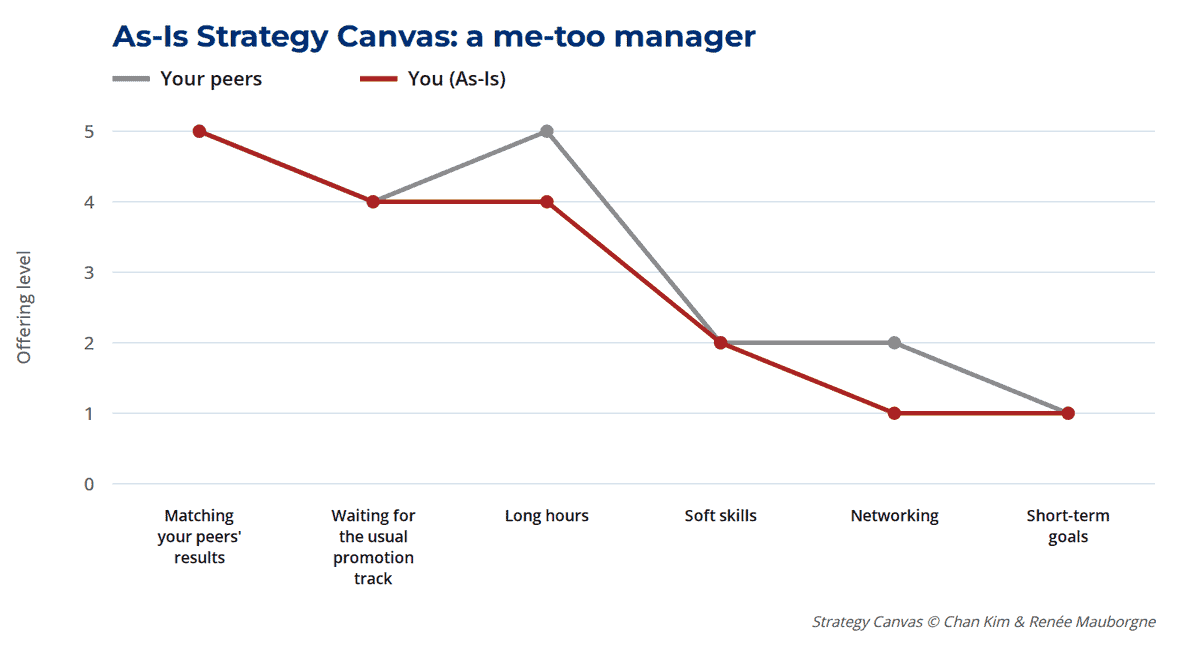
What you may find when drawing your strategy canvas for your career development is that, as ambitious or driven as you may be, your profile is not significantly different to others in the same track.
This leads to the next question: how can you expect to get noticed and promoted if what you ‘deliver’ in your position is no different to what your colleagues do? In business lingo, that makes you a ‘me-too’. It doesn’t matter if you’re an investment banker or an art auctioneer at Sotheby’s – if your strategic profile doesn’t stand apart from that of your peers, you’re a me-too.
Let’s take a look at a strategy canvas showing the career profiles of mid-career managers competing for the next role. There is not much differentiation, with most giving similar emphasis to factors including matching their peers’ results, waiting for the usual promotion track and working long hours.
Strategy Canvas © Chan Kim & Renée Mauborgne.
The Second Stage of Your Career Development Plan
The next steps involve visualizing where you could be in the future and finding out how to get there. Here, your task is to identify and assess potential blue ocean opportunities and develop alternative career strategies.
To do this, you need to think like a blue ocean strategist and approach your career development plan with a strategy in mind.
Visualize Where You Want To Be And How To Get There
Consider what factors of competition you can eliminate, reduce, raise and create that will help you to stand apart. You can do this by filling in the Eliminate-Reduce-Raise-Create (ERRC) Grid, a second blue ocean analytic tool.
Eliminate: Ask yourself which factors you and your peers compete on but that add no significant value to where you want to be.
Reduce: Similarly, which factors should you focus less energy on?
Raise: What factors, skills, or added value can you work on to be the very best and stand apart?
Create: What can you bring to the table that is different? What factors can you create that none of your peers has?
To reignite your career, you need to break away from your competition.
The Third Stage of Developing Your Career Plan
Once you identify which factors to eliminate, reduce, raise or create, you’re ready to plot them on the ‘to-be’ strategy canvas. This will show you in one simple visual how to stand apart from the competition and make a blue ocean shift in your career. Your career progression will be easier for you to visualize.
Create Your Dream Career with Blue Ocean Strategy
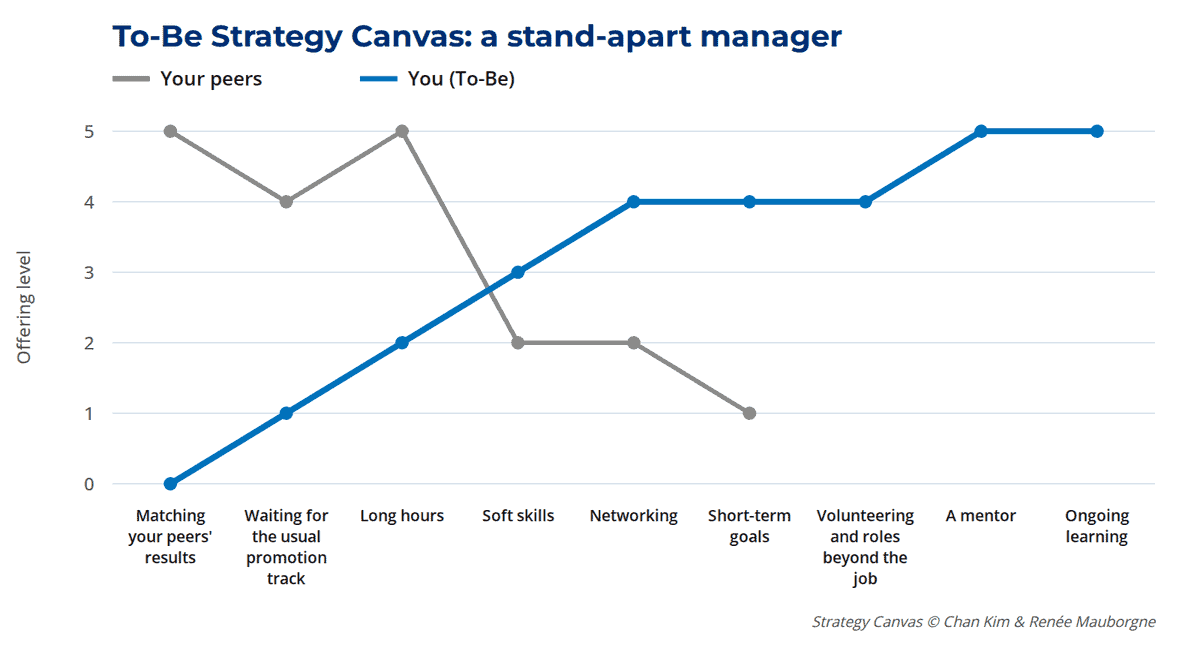
How to create your blue ocean ‘career space’? Let’s go back to the managers’ strategy canvas. Which of those factors could be eliminated, reduced and raised for a manager to stand apart from the pack? And what factors could be created that other managers aren’t doing or focusing on at all? Use the ERRC grid to determine which factors to eliminate, reduce, raise and create.
Strategy Canvas © Chan Kim & Renée Mauborgne.
Eliminate focus on matching your peers
As you can see in our example, we eliminated one factor: focusing on matching your peers. Don’t miss out on unique opportunities because you’re too focused on how to achieve what your peers have achieved. Broaden your thinking by looking across industries and beyond the obvious routes for your function.
Reduce long hours and conventional routes to the next role
Working longer than everyone else is the most common way to try to get noticed, and the easiest for your peers to match. So is waiting for the next opening on the usual promotion track.
Talk to people around you and tell them what you’re interested in.
One way of getting ahead is reaching out to people who do your dream job. Whether or not it will lead you straight to a job opportunity, you will gain some valuable feedback that will put you on the right track.
Raise soft skills, networking and short-term goals
Managers who were promoted for their expertise tend to focus less on perfecting their soft skills, networking and setting themselves short-term goals. You may be a genius data scientist (hard skill), but that won’t get you far if you don’t know how to communicate the results.
Make time to work on your soft skills – how you present yourself, how you communicate on your work, etc. These skills will help you become a better networker.
Networking skills aren’t just important to help you find a job – any employer will value your ability to create meaningful relationships on behalf of the company.
Although some people are able to create and stick to a long-term career development plan, this can be an almost impossible feat for most. Try to set yourself short-term goals and stick to them. It could be anything from an online course to exceeding your KPIs for the month.
Create opportunities to volunteer, find a mentor and keep learning
Volunteering, or any extra-curricular activity or responsibility, on the side of your job is another excellent way of avoiding tunnel vision. Pursuing a serious hobby or doing regular volunteering on the side is not only valued by employers, it is also a constant source of inspiration, creativity and discipline.
Finding a mentor and ongoing learning are both important goals that any professional who wants a successful career path should focus on. Just because you’ve finished studying does not mean you should ever stop learning. If your current skills are lacking, pick up new skills to progress in your organization.
Many companies have set up career development programs for their employees. Inquire with your manager or human resources about professional development opportunities in your company.
Using your career development plan with your team
If you manage people, the same three stages work for each person on your team. Ask them to draw their own as-is canvas, fill in the ERRC Grid together, and agree the short-term goals you will review at each check-in. Our guide to setting development goals for your team covers the goals themselves.
And remember, don’t focus on seeking hot or popular career opportunities. Don’t try to out-compete others to win in a crowded and cut-throat career space. Go for jobs that you love to do and are meaningful to you to create your own blue ocean career path.
Start drawing your ‘as-is’ and ‘to-be’ career strategy canvases right away.
And while your career development plans may change over time, the blue ocean strategic framework will help you adjust your strategy as you move forward to reach your ultimate career goal.
Frequently asked questions
What is a career development plan?
A career development plan, also called a professional development plan (PDP), is a strategy for your career. It gets clear on where your career stands now, then maps out where you want to be and how to get there in a way that sets you apart.
Is a professional development plan (PDP) the same as a career development plan?
Yes. Career development plan, professional development plan (PDP) and individual development plan (IDP) are names for the same document: where your career stands now, where you want to be and how to get there. HR teams often use PDP or IDP for the version you agree with your manager.
What should a career development plan include?
Six parts: where you are today, where you want to be, how to get there, short-term goals, who supports you (your manager, a mentor, HR) and when you will review the plan.
How do you create or write a career development plan?
In three stages. First, understand where you are today by plotting the key factors you compete on onto an as-is strategy canvas. Second, identify what to eliminate, reduce, raise and create with the ERRC Grid. Third, plot those changes on a to-be strategy canvas to see how you will stand apart.
How do you develop a career strategy?
Think like a blue ocean strategist and approach your career development plan with a strategy in mind. Ask yourself: Do you try to beat your competition or do you aim to make the competition irrelevant? Then consider what factors of competition you can eliminate, reduce, raise and create that will help you to stand apart.
What is an example of a career development plan?
The manager example above: eliminate focus on matching your peers; reduce long hours and conventional routes to the next role; raise soft skills, networking and short-term goals; create opportunities to volunteer, find a mentor and keep learning.
How often should you update a career development plan?
Whenever your role or goals change, and at least at each review with your manager. Your career development plans may change over time, and the blue ocean strategic framework will help you adjust your strategy as you move forward.
How is a career development plan different from professional development goals?
Goals are the individual targets. The plan is the strategy that ties them together and shows how each one sets you apart. For goal ideas, see 9 professional development goals examples.
Take blue ocean thinking from your career to your business
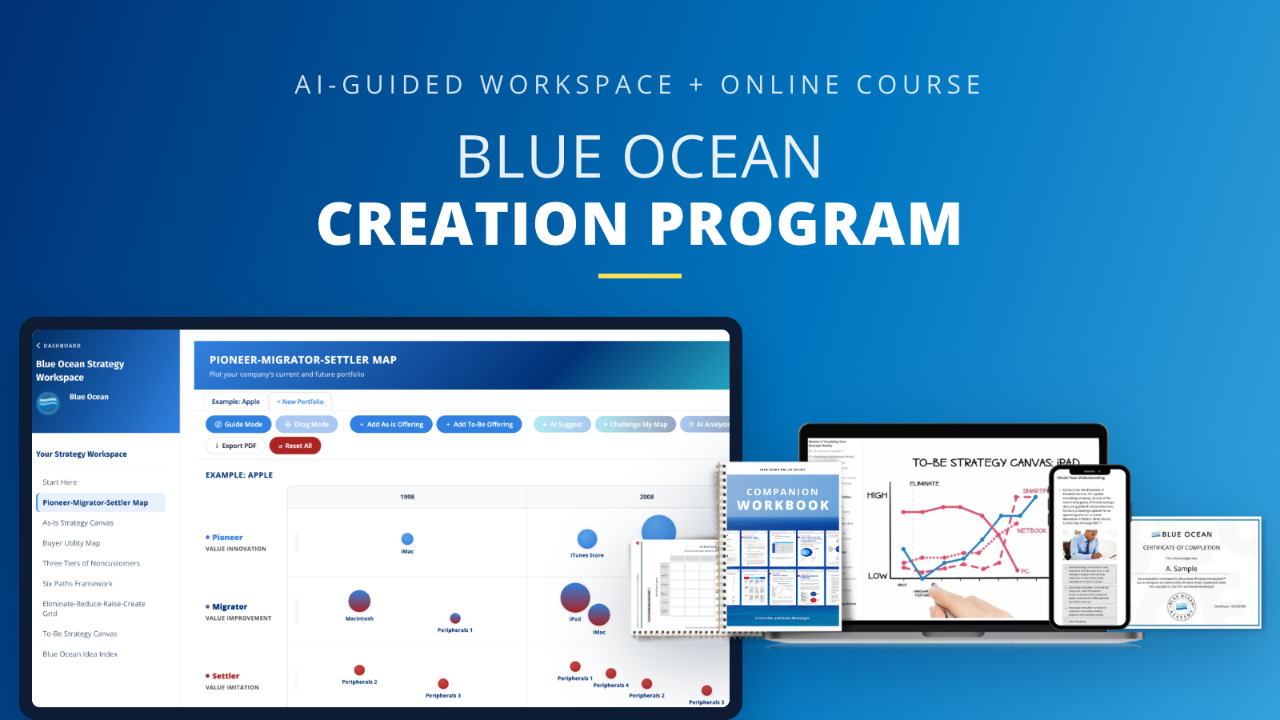
The Blue Ocean Creation Program is a self-directed workspace, online course and workbook that will help you learn and apply the tools, frameworks and processes to create a blue ocean.