
By David Yang
My first job out of university, in 2000, was at Seagate Technology, and I could not have asked for a better place to begin my career. The executives there were strategic and commercially sharp, but also genuinely committed to developing the next generation of leaders. I remain deeply grateful that Seagate was my start.
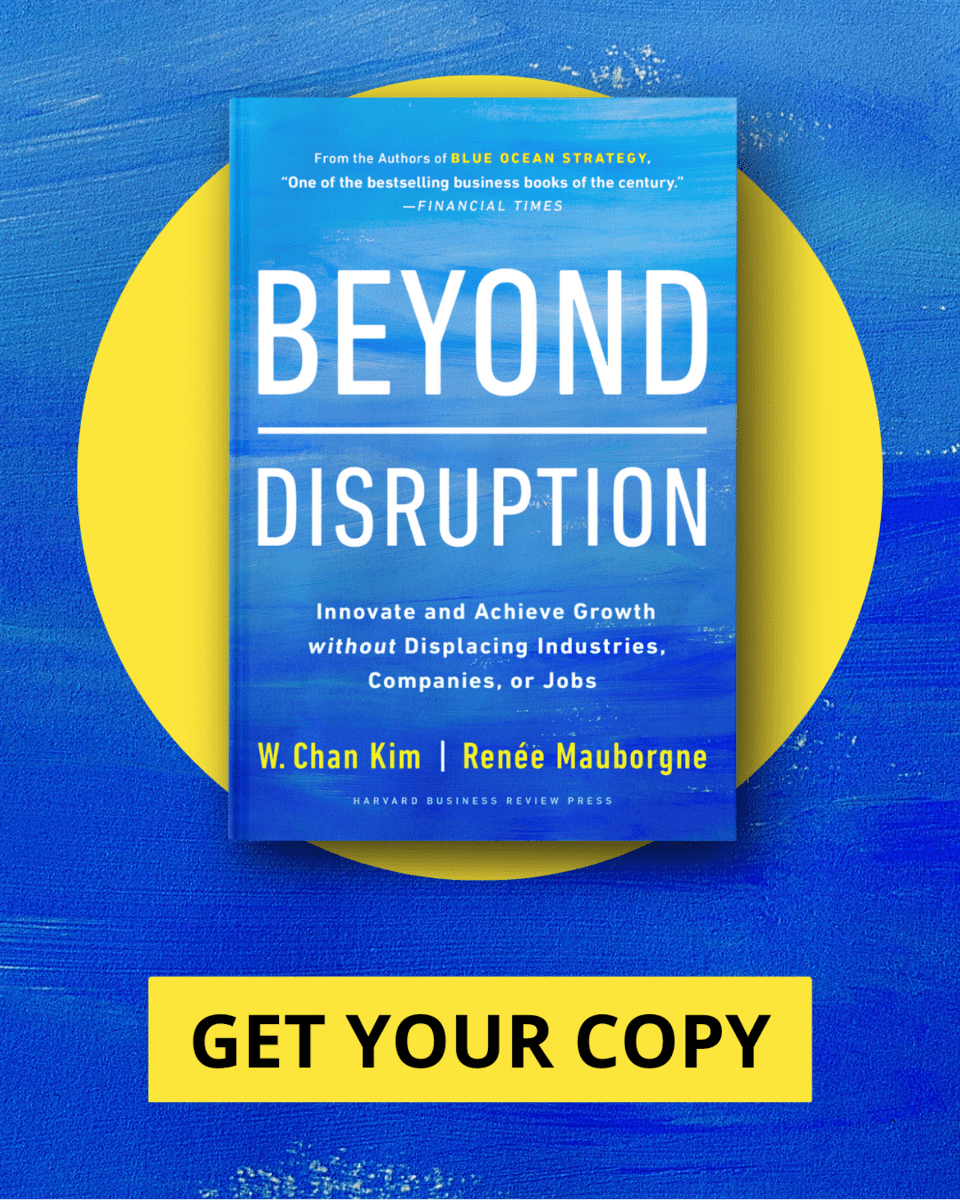
Around 2003, one of those executives introduced us to a way of thinking that would stay with me throughout my career: the principles that became known as Blue Ocean Strategy. The central idea was simple but powerful. Rather than fighting competitors for a larger share of an existing market, a crowded red ocean, companies should look for ways to create new market space and unlock demand that did not previously exist.
The goal was not differentiation for its own sake. It was value innovation: creating a meaningful leap in value for customers while also opening new economic opportunity for the business. Instead of accepting the rules of an industry as fixed, leaders were encouraged to ask what could be eliminated, reduced, raised or created.
At the time, I had just been assigned to Seagate’s emerging consumer electronics business, a new area for the company and very different from our traditional enterprise and personal-computing markets. The customers, the use cases and even the language were still being defined, so I could not rely on the established narrative around storage. We had to help customers understand why storage would matter inside a new generation of consumer devices. We were not really selling capacity. We were enabling new ways for people to access entertainment, carry their content and interact with technology.
That experience taught me an early lesson: some of the most compelling commercial opportunities appear before a market has developed a common language for describing them. Sometimes the role of a business leader is not to sell an existing product. It is to help customers see a future that is only beginning to take shape.
Four companies, one assignment
After Seagate, I moved through several companies and industries, and eventually found myself working at four companies during their pre-IPO journeys: Facebook, Snapchat, Reddit and Grab. The platforms were very different, but the assignment was remarkably similar each time. These businesses had attracted users, attention and engagement, but the commercial models around them were still developing. My job was not to take an established advertising product and compete for share. It was to work out how brands could participate within the native structure and behavior of each platform. It was, fundamentally, a Blue Ocean assignment.
At Facebook, that meant helping companies understand two enormous shifts happening at once: the move to social media and the move to mobile. When I joined, many of the commercial conventions of social advertising had not yet become standard practice. As one of the founding members of Facebook’s Asia-Pacific team, I helped define the platform’s value proposition across markets that differed dramatically in culture, language, technological development and consumer behavior. We were not just asking advertisers to move budget from one media channel to another. We were helping them understand a fundamentally different relationship between people, brands and technology. Social platforms let businesses communicate with customers in a more continuous, personal and participatory way, and mobile made that relationship available throughout the day, almost everywhere a person went.
The opportunity was not to win within the old boundaries of advertising. It was to expand those boundaries.
Snapchat
Snapchat was an even greater leap into the unknown. I left a comfortable role at Facebook to join a company of a little over 100 employees, known mainly as an ephemeral messaging app. How the platform would make money was not obvious to me, or to almost anyone else. But the users were there. Their attention was there. They used it every day, and they were spending meaningful amounts of time on it. I believed in the old adage that where time is spent, money will eventually be spent as well.
The challenge was finding a commercial model that respected how people actually used Snapchat. The answer was not to reproduce the banner advertising of the desktop internet, or even the feed of Facebook. It was to create experiences that felt native to a camera-first, mobile-first and highly visual platform. That thinking helped lead to advertising innovations such as sponsored lenses, filters and vertical video. At the time, those formats looked unconventional. Today, full-screen vertical video is one of the dominant forms of mobile advertising, and I had the privilege of selling many of those formats before they became industry standards.
That is one of the most fascinating things about Blue Ocean opportunities: what initially appears strange can eventually become standard. The objective is not to be different for the sake of being different. It is to understand customer behavior before the rest of the market recognizes its significance.
Reddit and Grab
My experiences at Reddit and Grab followed a similar pattern. Reddit was an enormous collection of deeply engaged communities, each with its own culture, interests and unwritten rules. The opportunity was not merely to place advertisements alongside those conversations, but to help brands understand how to participate in a platform built around community, authenticity and shared interests. Grab was another kind of ecosystem. What began as a ride-hailing platform expanded into food delivery, payments, financial services and other parts of everyday life across Southeast Asia. Its potential came from combining digital capabilities, physical movement and deep local-market knowledge.
In both cases, Blue Ocean thinking encouraged me to look beyond the most obvious revenue models. What unique value existed inside the platform? What behaviors were customers already demonstrating? What could we create that competitors were not pursuing? And how could we build commercial products that strengthened, rather than weakened, the underlying customer experience? Across my career, those questions have often been more useful than asking what another company is doing.
Blue Ocean Strategy is sometimes interpreted as the pursuit of entirely new industries. But a blue ocean does not always require inventing a new category. It can emerge when a company redraws the boundaries of an existing market, combines capabilities that were previously separate, or creates value for customers who were previously overlooked.
What Blue Ocean Strategy became for me
For me, it has become more than a business framework. It has become a way of approaching unfamiliar assignments. When entering a new market, I try not to assume that the existing rules are fixed. I look at where people are spending their time, how their behavior is changing and what needs remain underserved. Then I consider how the distinctive capabilities of a platform or business might create value that does not yet exist.
The common thread running from Seagate to Facebook, Snapchat, Reddit, Grab and now LinkedIn has been the chance to work in spaces where the commercial answers were not yet obvious. Those environments can be uncomfortable. There is no proven playbook, no perfect comparison and often no established benchmark for success.
But they are also where I have found the greatest opportunities to learn and contribute. More than two decades after I first encountered these ideas at Seagate, I still return to the same lessons. Do not limit your thinking to the market as it exists today. Do not assume the established way of creating value is the only way. Do not focus exclusively on competing for existing demand. Look instead for changes in behavior, overlooked customers and capabilities that can be combined in new ways. Create narratives that help people understand opportunities they may not yet be able to see. Build products and propositions that are native to the environments in which they operate.
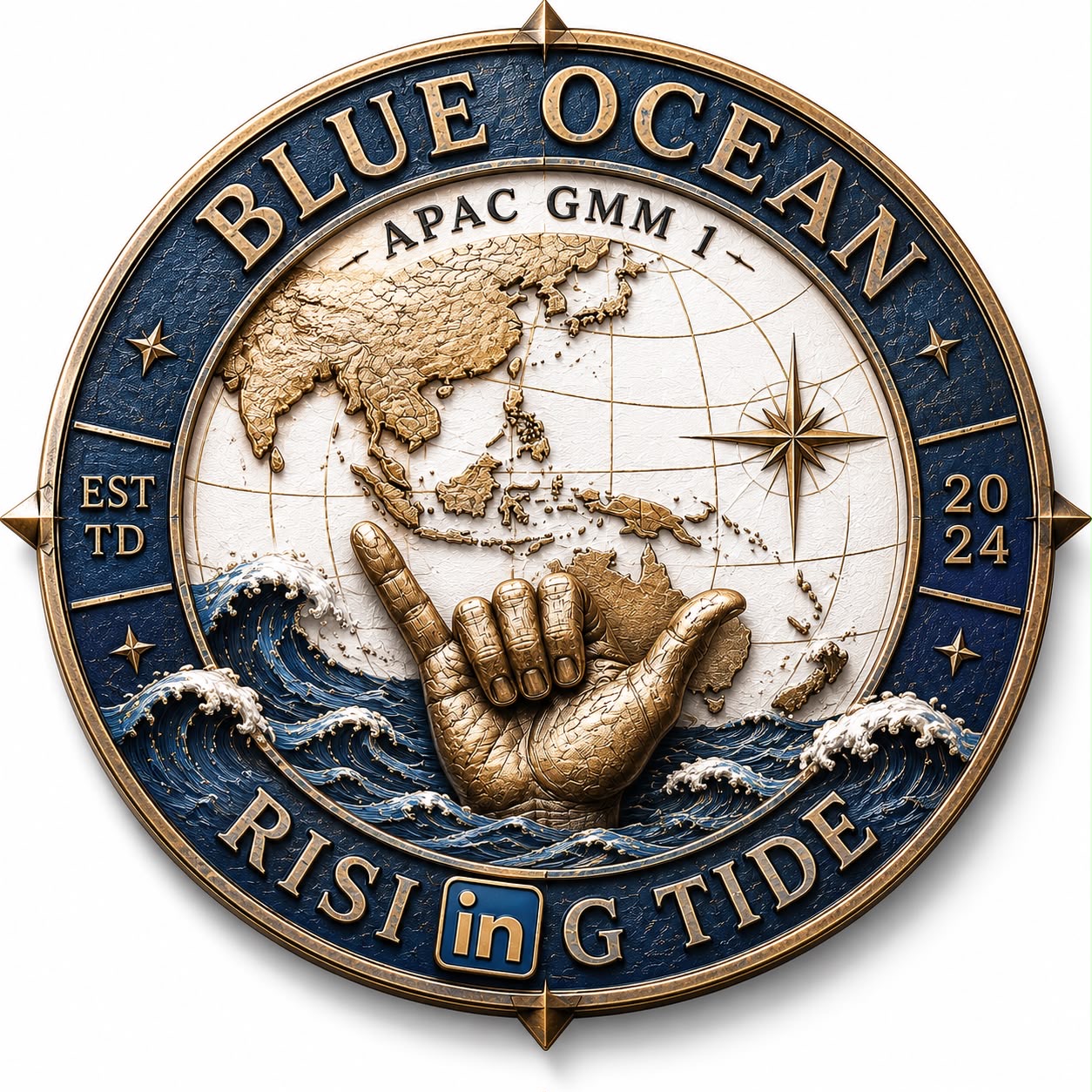
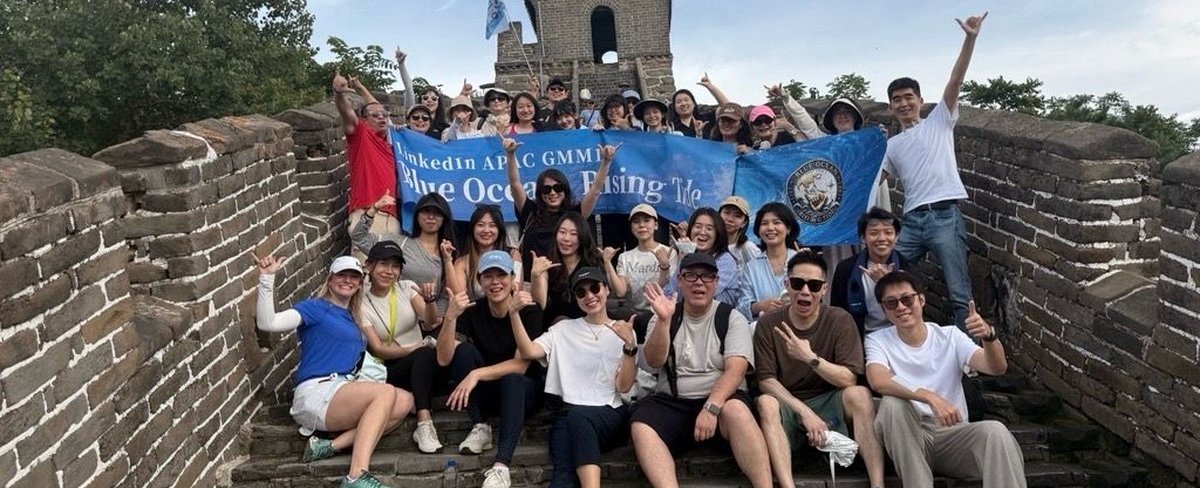
Today I am Managing Director for Growth and Mid Market at LinkedIn in Asia-Pacific, and the idea has come full circle. When we formed our team in 2024, we named it Blue Ocean. Not as a slogan, but as a reminder of how we want to work: to stop measuring ourselves only by the share we can win in today’s market, and to keep asking what value we could create that nobody is offering yet. The questions I first heard at Seagate more than twenty years ago are now ones the whole team asks together, and that has turned out to matter more than any one person asking them alone.
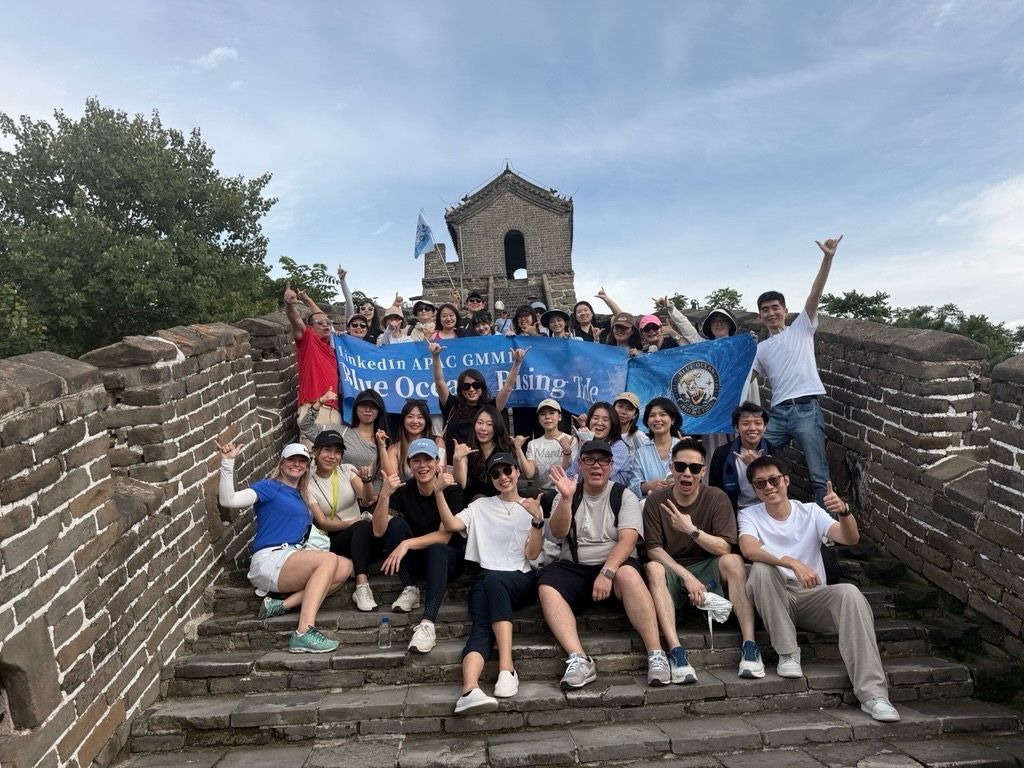
David’s LinkedIn APAC team, “Blue Ocean Rising Tide”, on the Great Wall of China.
Careers, like companies, can easily become focused on competing in crowded waters. Some of the most rewarding opportunities come when we are willing to leave those waters behind and search for a blue ocean.

About the author
David Yang is Managing Director, APAC Growth and Mid Market at LinkedIn, based in Singapore. Before LinkedIn, he worked at four companies during their pre-IPO journeys: Facebook, Snapchat, Reddit and Grab.