
WHAT ARE RED AND BLUE OCEANS?
The market universe is composed of two types of oceans:
red oceans and blue oceans
The market universe is composed of two types of oceans: red oceans and blue oceans.
What are red oceans?
Red oceans are all the industries in existence today – the known market space.
What are blue oceans?
Blue oceans are all the industries not in existence today – the unknown market space.
Why do we call them red oceans?
Cut-throat competition in existing industries turns the ocean bloody red. Hence the term ‘red ocean’.
Why do we call them blue oceans?
Unexplored and untainted by competition, ‘blue oceans’ are vast, deep, and powerful in terms of opportunity and growth.
What is red ocean strategy?
Red ocean strategy is all about competition. As the market space gets more crowded, companies compete fiercely for a greater share of limited demand. LEARN MORE.
What is blue ocean strategy?
Blue ocean strategy creates new demand. Companies develop uncontested market space rather than fight over a shrinking profit pool. LEARN MORE.
What outcomes does red ocean strategy produce?
Competing in red oceans is a zero-sum game. A market-competing strategy divides existing wealth between rival companies. As competition increases, prospects for profit and growth decline.
What outcomes does blue ocean strategy produce?
Creating blue oceans is non-zero-sum. There is ample opportunity for growth that is both profitable and rapid.
ORIGIN OF THE TERMS
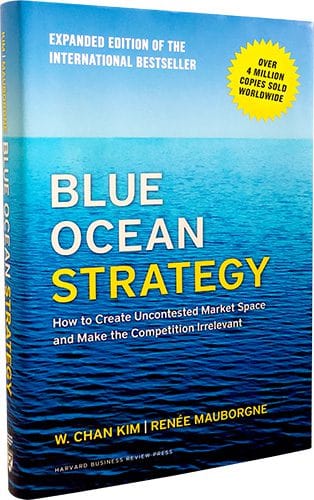
Professors Chan Kim and Renée Mauborgne introduced the concepts of red and blue oceans in their international best-seller Blue Ocean Strategy. First published in 2005, it was updated and expanded with fresh content in 2015. It has sold over 4 MILLION copies and is being translated in a record-breaking 49 LANGUAGES.
—— APPLY IT
BRING A REAL PROBLEM.
LEAVE WITH A STRATEGY.
Reading about blue ocean strategy is one thing. Applying it to your own business is another. Two programs take you through the process step by step, on a real challenge of your own.
—— SELF-PACED
BLUE OCEAN CREATION PROGRAM
A proprietary AI-guided workspace where blue ocean tools come to life on your business, and an online course to learn the concepts as you apply them. Get a clear direction to grow your business, increase revenue, and unlock new markets. Best if you want to move at your own pace and start immediately.
—— LIVE COHORT
BLUE OCEAN STRATEGY PRACTITIONER PROGRAM
Apply Blue Ocean Strategy to a real situation: an organizational strategy, a business of your own, or a client engagement, with expert feedback at every step. Leave with a growth roadmap and the momentum and confidence to implement it.